
The business
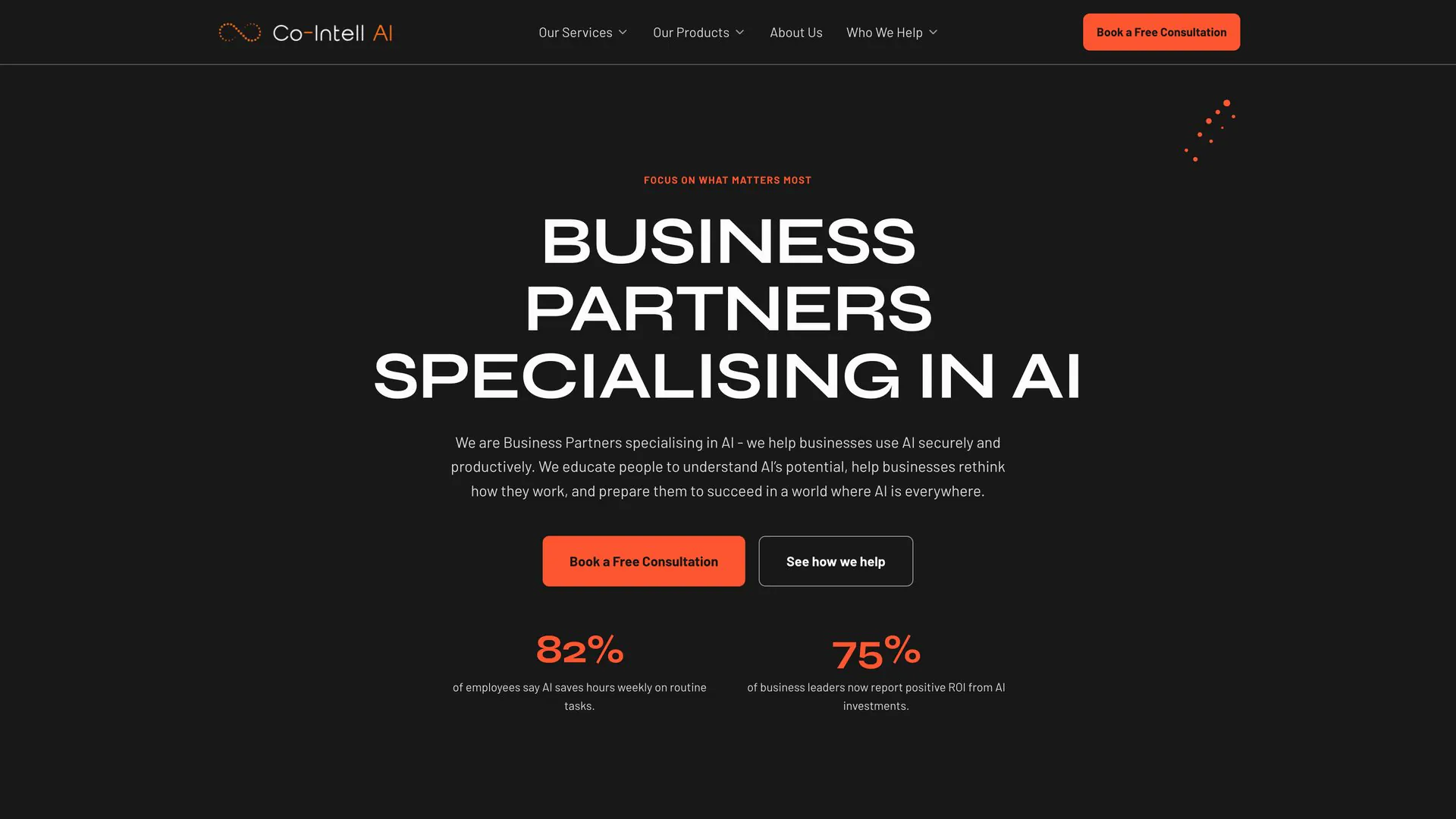
Co-Intell AI is an AI training, implementation and consultancy firm based in Hawke’s Bay, New Zealand, working with organisations across New Zealand and internationally. Its founder and CEO, Tim Pearce, positions the firm as a business partner specialising in AI, and the premise sits in the name: co-intelligence, people and AI working together rather than AI replacing people. The firm’s services span AI training, AI build and AI transformation.
The starting point
Tim came to us with a name he believed in, two colours he wanted to build around, and a business to launch. Everything else was still to be made: the logo, the palette, the website, the copy, the domain, and the systems the company would run on day to day. At that stage every decision costs little to get right and a lot to unwind later, so the brief was to build the foundations once, properly.
What Pellmark delivered
- Naming advisory: pressure-tested the Co-Intell name against the positioning it had to carry
- Brand identity: logo designed from a blank page, with a full colour palette and brand assets for web and social media
- Website: designed, written and built from scratch, with a full refresh since
- Copywriting: every page written by Pellmark, revised with Tim as the business evolved
- Company systems: platform advisory and setup for the firm’s internal infrastructure, including Google Workspace, plus domain setup
- Ongoing management: a monthly partnership covering content, service and team changes since launch
The work in detail
The name. Tim coined Co-Intell before we met. Our role was advisory: to test the name against the business he wanted to build and confirm what it should signal. It holds the firm’s central idea, people and AI working side by side rather than one replacing the other, and that idea became the organising principle for everything that followed.
The mark. We started from what the business actually believes rather than from shapes. Co-Intell exists on the premise that people and AI achieve more together than either does alone, and the firm works in Hawke’s Bay, so the identity also had to sit comfortably alongside concepts the business itself draws on: whanaungatanga, relationships; kotahitanga, unity; mātauranga, knowledge.
We designed five concepts against that brief and wrote the reasoning out for each one: pixel blocks phasing into a human head; an infinity symbol formed from a human arm and a robotic arm meeting in a handshake; an infinity symbol split into one solid half and one pixelated half; a figure divided down the middle, half human form and half data; and a text-only mark carrying the idea through typography alone. Two went to the shortlist. Tim chose the infinity.
What shipped is that concept drawn properly. One loop of the infinity is a continuous solid line, the human side. The other is built from discrete dots, the machine side. They meet without a seam, which puts the argument of the entire business into one shape, and the closed loop carries the continuity the name implies. The wordmark beside it takes the idea from the shortlist’s other finalist: “Co-Intell” sits in white and “AI” in orange, so the letters make the same point the symbol does. It ships in horizontal and vertical lockups so it holds up across the website, documents and social formats.
The palette. The brief was black and orange. The obvious execution of black and orange is the one most AI brands reach for: saturated orange on pure black, high contrast, deliberately robotic. We built the opposite, and the reasoning was partly about register and partly about arithmetic.

- Canvas black#181818Page ground. Carries white body text at 17.3:1.
- Warm charcoal#332A29Raised surfaces. Warms the ground without lifting it.
- Signal orange#FC552FTitles, highlights and calls to action only. 5.5:1 on the ground.
- Pastel peach#F0C8B0Large fills. The move away from the default AI look.
- White#FCFCFCBody copy and keyword emphasis inside grey subheadings.
The ground is a dark grey rather than true black. Black under white text produces a hard edge that tires the eye over long reading, and this is a site people read: the firm sells training and consultancy, so its pages carry explanation, not slogans. Dark grey holds the tone Tim asked for and stays comfortable at length.
Orange does the pointing, and only the pointing. It marks titles, highlighted phrases and calls to action, because a colour that means “look here” stops meaning anything once it is everywhere. The arithmetic backs the rule up: against white the orange sits at 3.2:1, which makes it a display colour rather than a body colour, so it never carries running text. On the dark ground it reaches 5.5:1 and holds small text safely. Softening it towards peach for large fills is what gives the palette its calm register and moves it off the bright-orange-on-black default.
White carries the body copy at 17.3:1, comfortably past the strictest accessibility threshold. Grey handles subheadings so hierarchy reads without extra weight or size, with individual keywords lifted back to white where the eye should stop. The hero buttons are black rather than orange: on a dark grey ground a black button is a shape rather than a shout, which suits a firm whose pitch is judgement rather than urgency.
The typography. Three faces, each with a defined job and a written reason for holding it.
Set in capitals throughout. Syne is a display face with unusually wide, slightly irregular letterforms, so a heading has a distinct silhouette at a glance instead of reading as the default sans every other consultancy uses. Capitals give the headings a fixed height and a firm edge, which is what makes them work as anchors for someone scanning rather than reading. The same face carries blockquotes and figures, so every moment that needs weight speaks in one voice.
One job, one place. Poppins is geometric where the body face is not, so the opening paragraph of a page reads as a distinct register without a size jump or a dividing rule. Each page gets a hook that is visibly the pitch, then hands over for the detail.
A low-contrast grotesque with open letterforms and a large x-height, which is the combination that survives small sizes on screen. On a site explaining AI to people who have not bought yet, the body face has one job and it is not to be noticed. Running the navigation in the same face keeps the interface quiet and the headings loud.
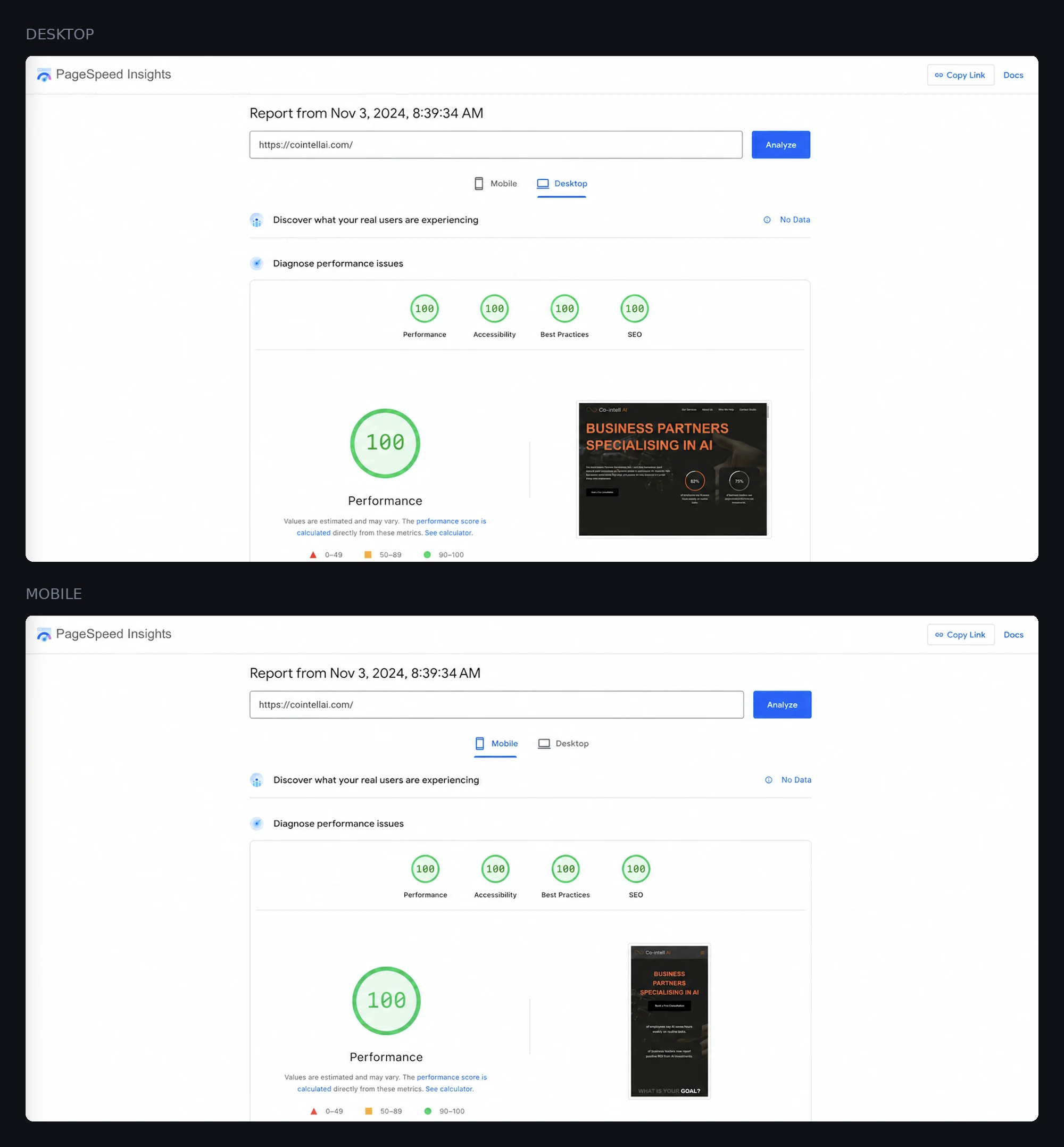
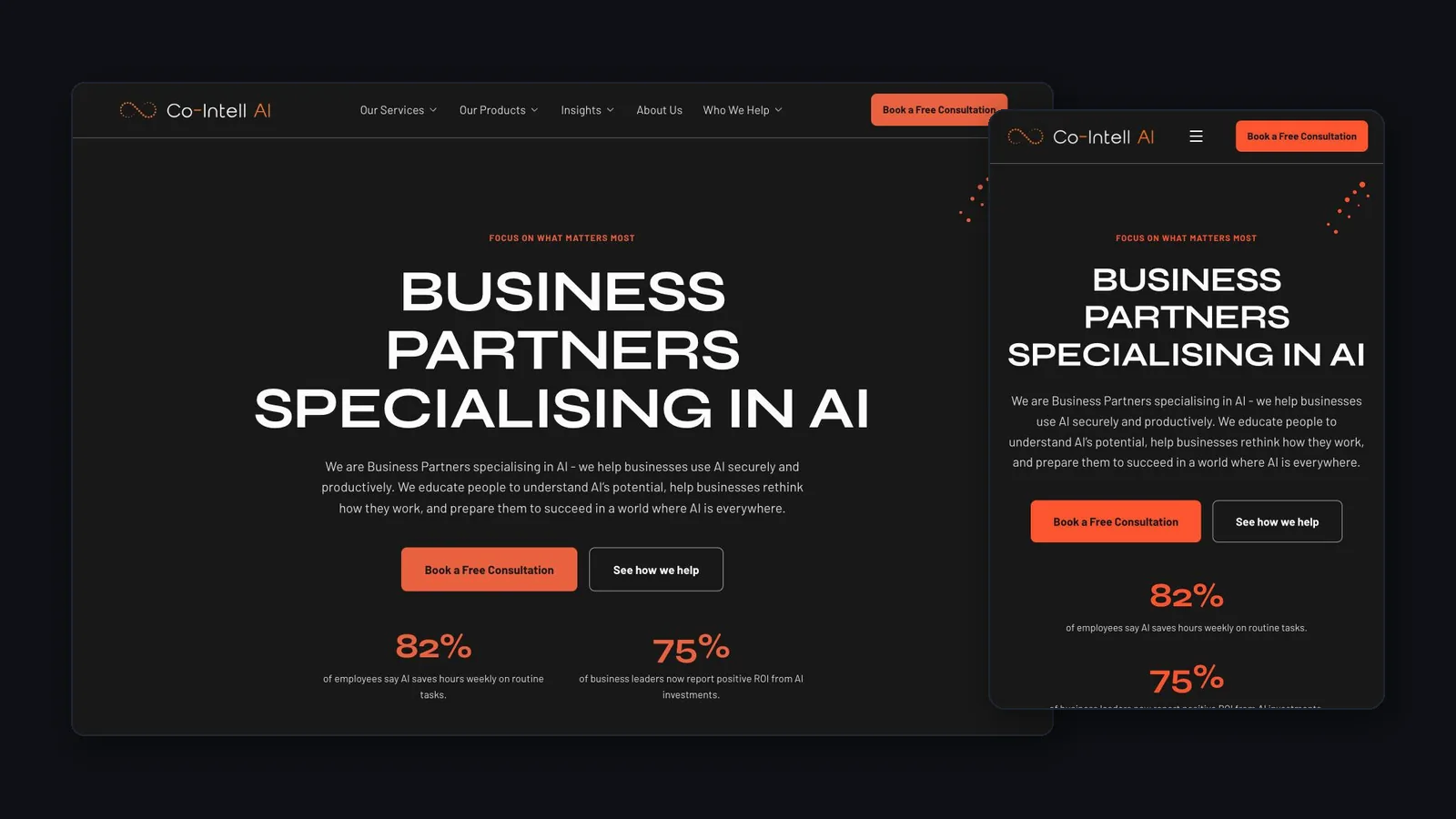
The website. We designed, wrote and built the site from a blank page. The first build ran on WordPress and performed well, but the firm kept growing and this is an engagement we control end to end, so we rebuilt the site from the ground up as a custom React and Next.js build. That control is why it holds 100 in every PageSpeed category on both mobile and desktop rather than drifting between releases: we own the stack, the deployments and the maintenance, so nothing lands on the site that we have not measured. The copy has evolved the same way: written by us, revised with Tim, and updated as the services changed.
The standard is not a property of the current build. The first site scored 100 in all four categories on both devices too, on a different platform and an entirely different design. Two builds, two technology choices, the same result, which is the part we would rather be judged on than any single score.
The systems. A new firm also needs an operating foundation. We advised on internal platforms, weighing Google Workspace against Microsoft Teams for how the team would work in practice, helped with setup, and put the domain and company infrastructure in place.
The partnership. Co-Intell AI has not stood still: new people, new services, new platforms. The work runs between our UK studio and Hawke’s Bay on a monthly rhythm, so the website and brand keep pace with the business instead of falling behind it.
What we can measure
A site that launches well and then decays is a common outcome. This one is measured on the same instruments today that it was at launch, and it is the build where we control every layer. The report below is current and the site is live, so none of it has to be taken on trust. The design decisions above are measurable too: contrast is arithmetic, not opinion.
Google PageSpeed Insights, desktop
- 100Performance
- 100Accessibility
- 100Best practices
- 100SEO
Google PageSpeed Insights, mobile
- 100Performance
- 100Accessibility
- 100Best practices
- 100SEO
Machine access and design
- 2 of 2Google agentic browsing checks passed
- 17.3:1Body text contrast, against a 7:1 AAA threshold
- 3Typefaces, each with a defined role
- 17Months managed, no rebuild
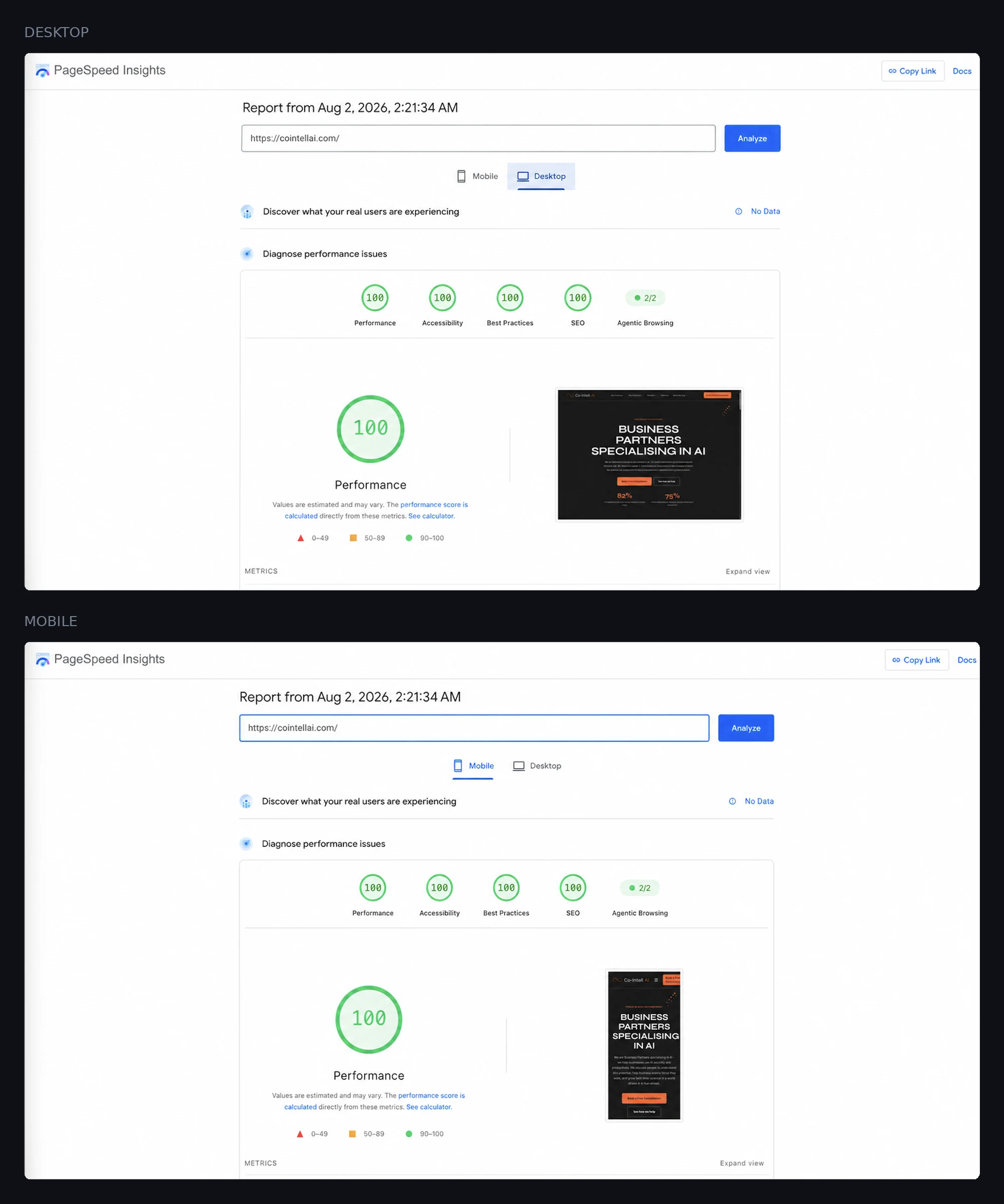
Performance and accessibility figures are from the Google PageSpeed Insights run above, published as captured rather than cropped. This one is a live site on a current report, so anyone can put the address into PageSpeed Insights and check the numbers against ours. Contrast ratios are calculated from the published palette values and can be reproduced from the hex codes above. Google’s agentic browsing checks test whether an automated agent can reach, read and act on the page, which is how a growing share of buyers now arrive at a business.
The result
The response Tim reports from his own market is the result we care about most: people who see the site tell him it is ahead of anything they have seen locally. Tim also reports a significant rise in enquiries and visibility since launch, and that Co-Intell AI is now regarded as one of the most trusted and premium providers in its region, a standing he puts down to the quality of the brand and the site. The engagement is also proof of the model: a free initial build, then twelve months of Premium Care at no charge. That is the package our Win a Free Website winners receive today. The one element Tim paid for during that year was the identity work, and it came in at less than half of what he had been quoted for it in the market. And when the free year ended, Tim stayed: the partnership continues today on the same footing, 17 months from the first call and counting.
On commercial results. Every figure on this page is one we can measure ourselves. Enquiry volume and revenue sit inside the client’s business, not ours, so we do not estimate them and we will not publish a number a client has not approved word for word. We are gathering a full year of trading data with each client we manage and will publish what they are willing to share, in their own wording, once it is verified. Until then this page carries what the instruments show and what Tim has told us directly, and nothing else.
Live site: cointellai.com